The Best Magazine You’re Not Reading

IEEE Spectrum.

It’s that simple.  Unless you are an electrical engineer, you’ve never heard of it.  And you are missing out.   (I love Wired, of course, but you probably already read that.  If not, one place to start is its two security blogs.)

Celebrating 50, Spectrum reviews some of its historical highlights here, with access to classic articles.  But then look forward – debating wind farms in Mexico, Skype Translator, 3D printing of high-tech contact lenses, and what seem like weekly advances in robotics.

The argot is rarely out of reach of the gen pop.  Instead, you get a peek into what the rest of us will be reading about in biomedicine, software, energy, robots, more – and buying and doing and having done to us – in the future.  But you can read it here first.

Bienvenidos a Cuba

I thought this would be the first thing Obama did in 2009 – and in 2013.  A key question now is whether this is domestic policy (ideological, electoral) or foreign policy (countering a rise in Chinese influence?). Some of the other questions we will see debated endlessly in the near future include:
A Cuban perspective

– what was the role of U.S. gaming industry? agricultural exporters?

– will this advance democracy in Cuba? Is China instructive here?
– will this improve the economy in Cuba?  The obvious answer might be Yes, but look at Jamaica, Puerto Rico, the Dominican Republic, Haiti…. Disney Cruises and Diet Coke don’t make your economy boom.
– will this benefit “ordinary” Cubans? Who will benefit and who will lose – from the rise in tourism jobs but increased prices for everything from food to real estate….
– how will this influence Marco Rubio’s nomination prospects, or Jeb Bush’s?
– in 10 or 30 years, where will this rank in Obama’s foreign policy legacy?
– what is the role of Pope Frances in shaping this or other aspects of U.S. foreign policy?
– when do Spring Break Habana ads start appearing on Instagram?

Plan the work, work the plan.

Plan the work, work the plan.

Paul Clenen Bishop said this over and over, as advice to himself and to others.   Assembling train sets as a kid, as a high school student on a Liberty Ship, for more than 40 years in the United States Navy and as a Navy civilian, and as a small business owner working for the Navy, Paul would plan the work and work the plan.

His work was noticed, whether “inventing the Internet”, or keeping sailors and sea lanes safe, or helping with the Navy’s newest ship, or working with the Panama City Chamber of Commerce, and a wide range of other efforts. The Navy awarded him the Superior Civilian Service Award. He was a Senior Member of IEEE, and founding chair of its Marine Systems Coordinating Committee.

Away from work, though, he would sometimes go without a plan.  One familiar treat was a good meal on the road.  Often he would trust that treat to the waiter or waitress.  And what would you like, sir?  “Please bring me something good.”  Uh…. Can you give me guidance? What do you like? “No, I trust you. Surprise me,” handing back the still-unopened menu. Continue reading “Plan the work, work the plan.”

Forgetting the Presidents?

What Presidents will we forget – or our grandkids never hear of at all?  In AAAS’ Science, Washington University of St. Louis scholars Henry L. Roediger III and K. Andrew DeSoto offer one analysis.  But I’m guessing they’re wrong.

Their idea is based on the idea that people are good at remembering the beginning of lists, and the end, but only remarkable items along the middle of the list.  Using data collected from surveys of undergrads in 1974, 1991, 2009, and an adult survey in 2014, they found that Washington,  Lincoln, and recent presidents are recalled, but those more than a couple of generations past are forgotten.

But there are a number of advantages that recent and all future presidents will have over McKinley and Fillmore:  video, a strong executive branch, and global authority.

Continue reading “Forgetting the Presidents?”

Mr Gorbachev, Tear Down this Wall

The CBS News radio report continued – “And something else remarkable – border guards dancing on top of the Berlin Wall….”

In the past few years, college-aged students were dramatically shaped by 9/11, or by long wars, or the by the election of an African-American President. Earlier generations had the JFK assassination, or Vietnam and the civil rights movement, or World War II, or the Depression. Maybe today’s undergrads have not yet had that which will shape their political lives.

But for many in one generation, political maturation was shaped by the evolution of the Reagan Administration and the evolution of the Cold War – from hard-line anti-communism to deals with Gorbachev, from the 1979 Soviet invasion of Afghanistan to democracy in Eastern Europe – and most dramatically illustrated by the breach of the Berlin Wall.  

Continue reading “Mr Gorbachev, Tear Down this Wall”

Back to Bosnia, on France24

Based on earlier posts here, France24’s Les Observateurs shared this version on their web site.

Back to Bosnia

By Team Observers on 30/10/2014 – 16:18.

By Jim Quirk
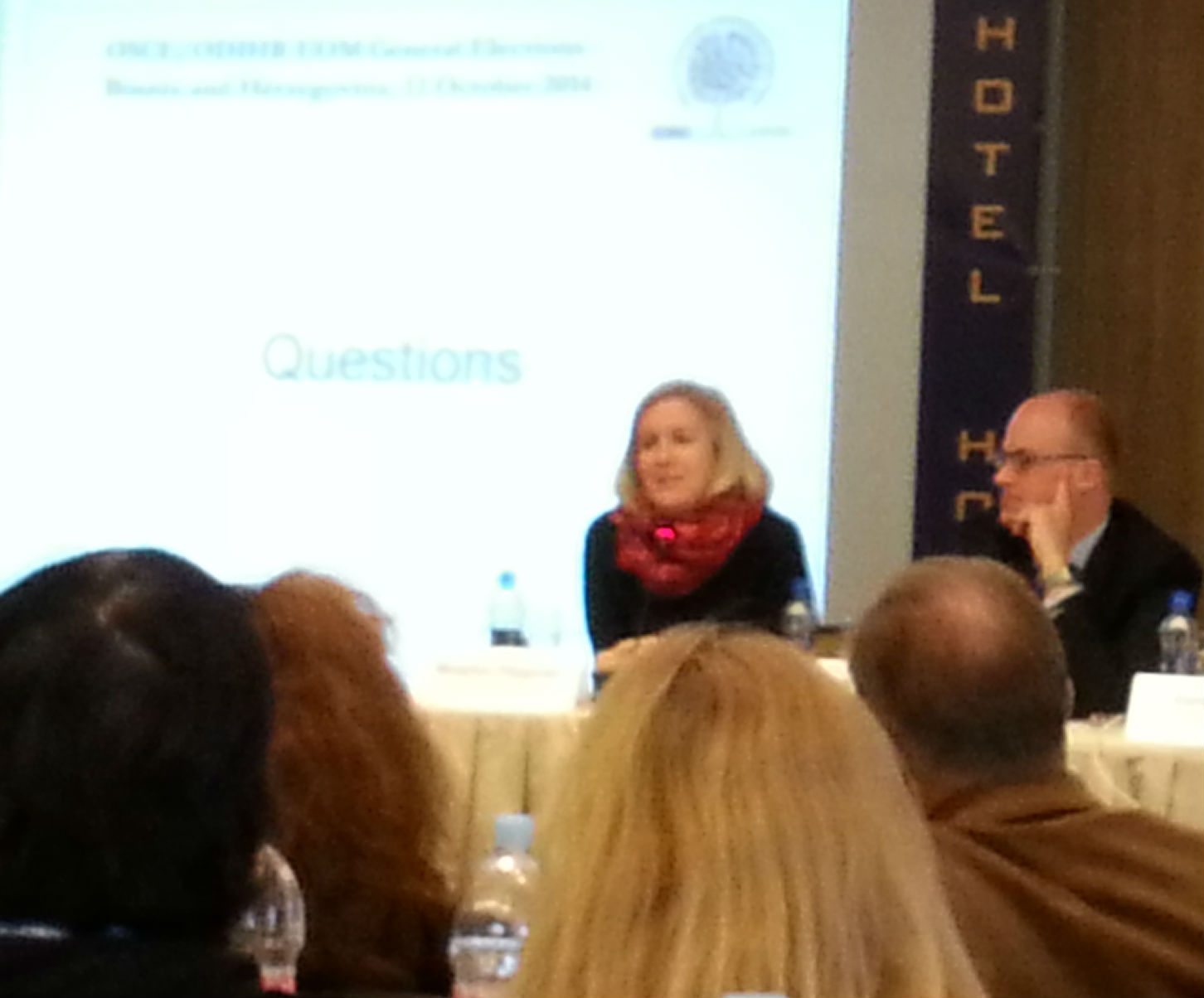
After 17 years away, I returned to Bosnia in October as part of the OSCE Election Observation Mission. It was in part exciting, rewarding, and disheartening.With the ballots counted, the presidents named, and the parliamentary coalitions in the making, we can begin to make notes about the future of Bosnia.
Continue reading “Back to Bosnia, on France24”

Airlines and Sick Passengers – updated

Update:  United Airlines responded as well, with the following email.  The reply from Austrian Airlines, posted here earlier, is further below.

“Thank you for contacting United Airlines; we appreciate your sharing your concern.

“To answer your question, yes we do have records in place of all incidents that happen on the aircraft and have methods in place for tracking.

“If in fact that an individual from your flights on October 7th were found to be contagious, and it affected any passengers direct health you would have received a phone call directly from United Airlines.

Continue reading “Airlines and Sick Passengers – updated”

In Response to the Perception of Electoral Integrity Index

20141012_101412voterscropped
Voters in Bosnia, Oct 2014

In the current issue of PS: Political Science and Politics (47:4, October 2014), Pippa Norris, Richard W. Frank, and Ferran Martinez i Coma announce a new dataset for “Measuring Electoral Integrity around the World.”  In the spirit of Freedom House, Transparency International, and other global indices, the Electoral Integrity Project surveys experts on 49 indicators for a particular election, and generates a PEI index on a 100-point scale.

The authors anticipated relationships between electoral integrity and liberal democracy, democratic history, and  economic development.  They found these, with some interesting exceptions.  They also find that media and campaign finance, not just ballot box integrity, are important.  To be sure, this effort will become an important contribution to the study of elections, political development, democratization, and more.  But it risks suffering from a serious flaw – one that might have a simple, partial solution.  Continue reading “In Response to the Perception of Electoral Integrity Index”